
What AI Got Right, What It Got Wrong, and What I Had to Fix Myself (Copy)
This article was originally published on LinkedIn
I've used AI throughout the launch of Against the Grain. Research, drafting, images, SEO, site work, social scheduling, etc. I'm not going to pretend otherwise, and I'm not going to oversell it either.
There's a lot of noise right now on both sides. One camp acts like AI does the work for you. Another treats it like it's beneath a real business owner to touch it at all. And yet another fears it. I land in the camp that sees AI as an effective tool when in the hands of a skilled practitioner.
In distilling terms, I liken AI to the yeast that enables fermentation.
Yeast is a naturally intelligent tool, as opposed to an artificially intelligent one, but it still makes for a solid metaphor.
You pitch yeast into the mash, and it goes to work on its own, converting sugar into alcohol without anyone standing over it giving instructions. Real, autonomous, transformative work. But the distiller still picks the strain, still controls the temperature, still knows what a healthy fermentation smells like versus one that's gone sideways. Get the conditions right, walk away for a few days, and it does something genuinely impressive by itself. Get them wrong, or stop paying attention, and it ferments its way to something you can't use, just as confidently as it would have made something great.
AI has been that for me this launch. Here's the honest version of what that's looked like.
What it got right
AI is a genuinely good research assistant. Pulling historical threads on bootleggers, cross-checking dates, and drafting first passes at emails and posts is fast, and it's freed up hours that I've put back into the other things only I (or humans) can do.
It's also a decent editor. Tighten this. Cut that. Does this sound like me or does it sound like a press release? AI is useful for that kind of pass, the same way a second set of eyes on a barrel sample tells you something you can't taste alone.
Early on, I even had it draft an initial outline for the manuscript based on the concept I presented to it. Not the content, just the structure. I changed most of it before the manuscript was done, but AI gave me a starting shape to argue with instead of a blank page to stare at.
That's a real use case: not "write my book," but "give me something to push back against."
Images, two different ways
I use AI for photos in two directions. Sometimes I take a real picture. Maybe it’s an old newspaper clipping, a shot from the shop, or a picture of a cocktail I made on the kitchen counter. I then use AI to clean it up or enhance it so it holds up online. Other times I start with nothing but an idea in my head and generate something from scratch to match it.
Very rarely is it one-and-done. It’s a process.
Either way, the non-negotiable is that it has to look like it belongs to the brand. Bourbon brown, copper, cream. If an image doesn't fit that palette, it doesn't go up, no matter how good it looks on its own. AI doesn't know what "on brand" means until I tell it, and even then I'm the one deciding when it's actually right.
Some example images follow
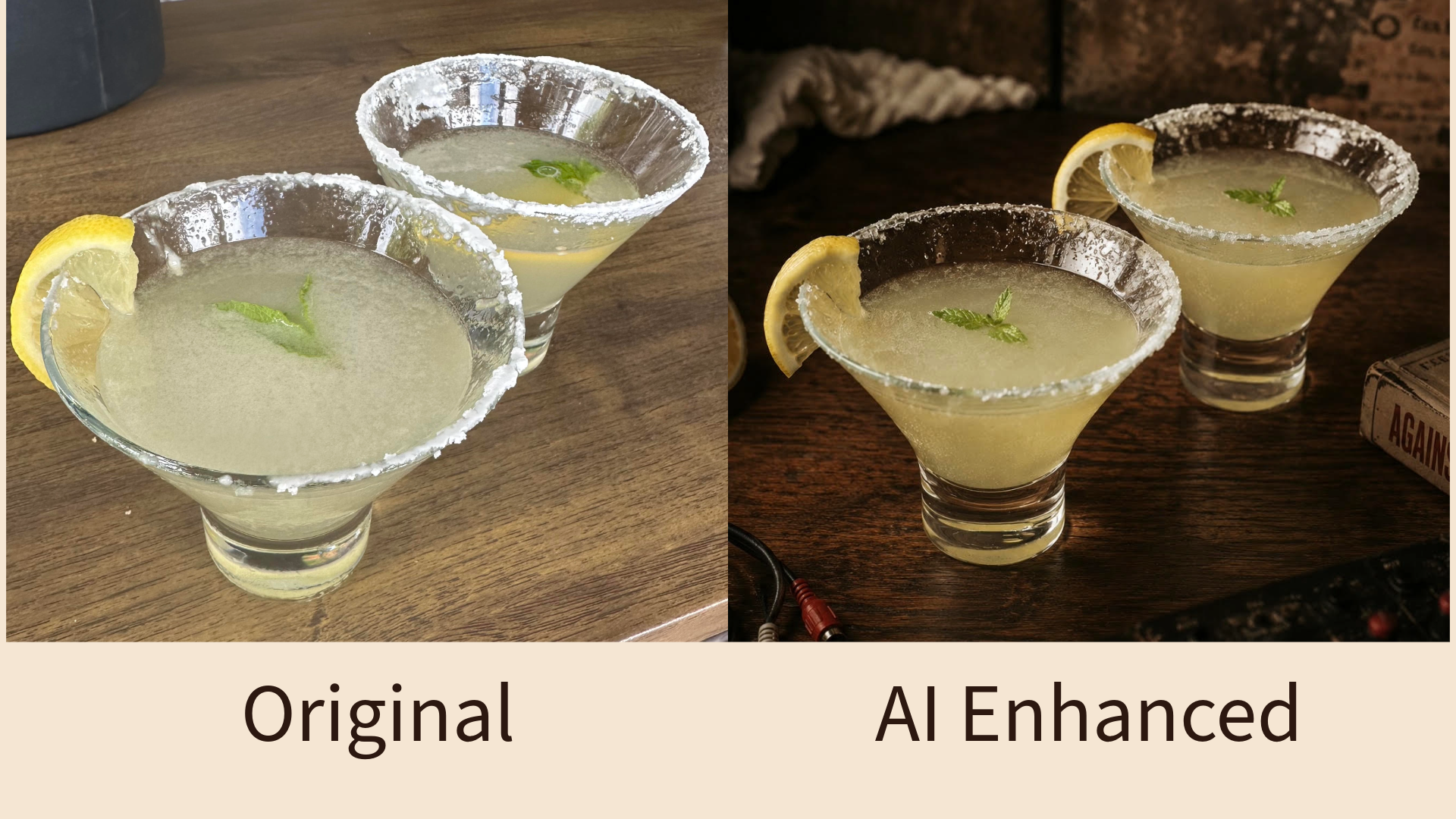
Lemon Martini
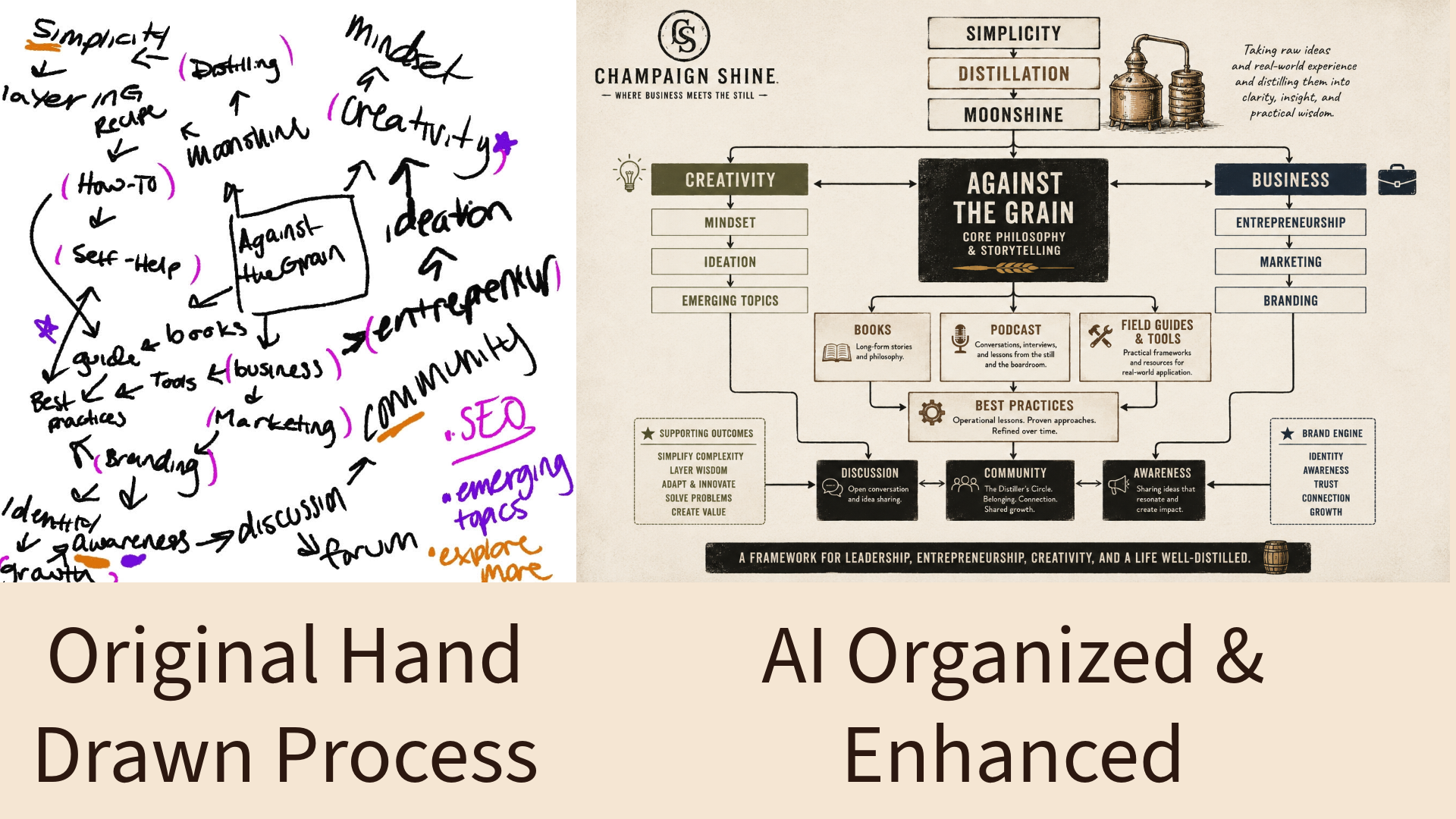
Mind Map
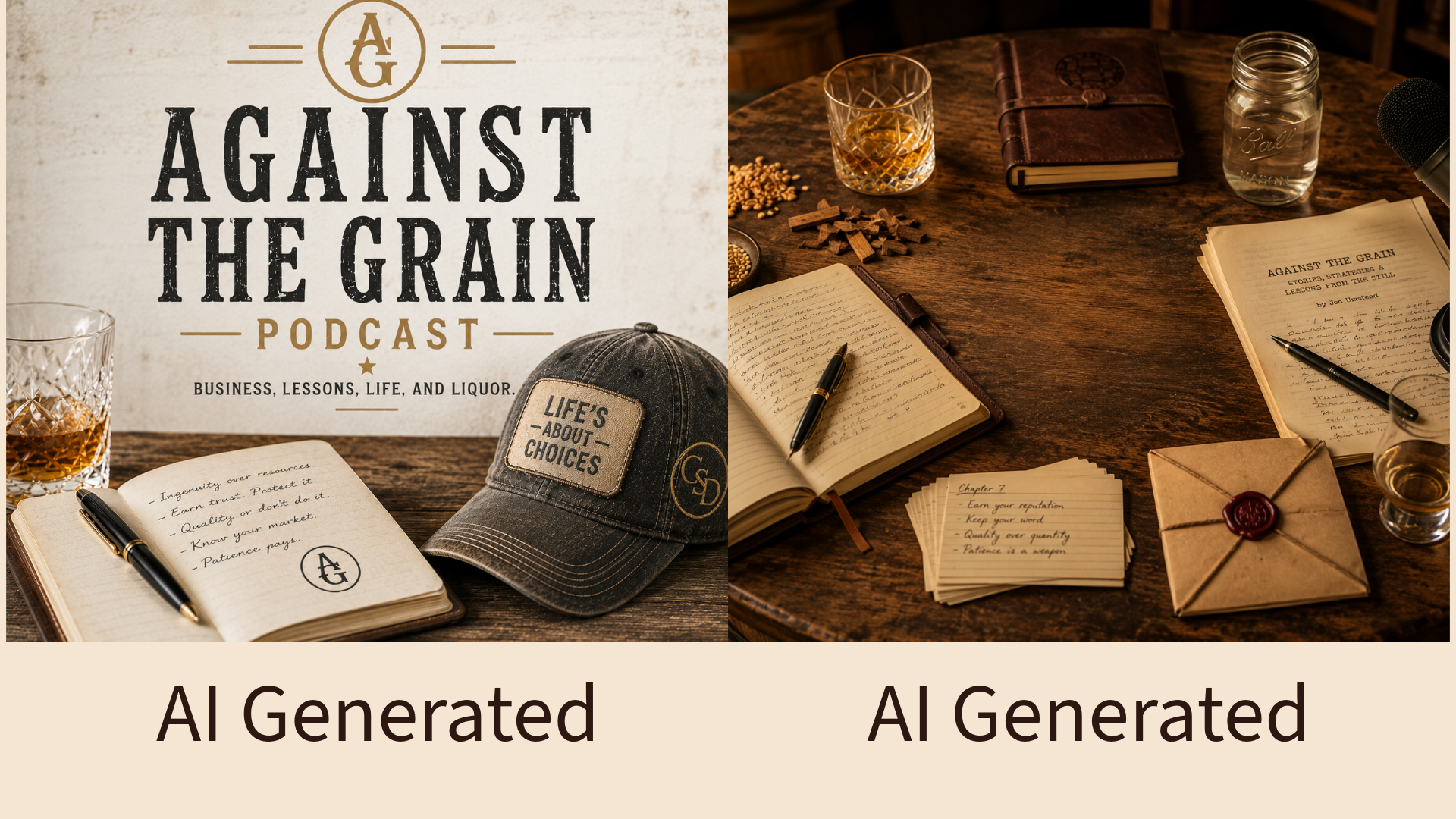
Cover Image and Banner Image
SEO, article by article
Every piece of content, like articles, blog posts, podcast episodes, has its own SEO considerations. What keywords make sense? How should it be categorized, what's worth optimizing for search versus what's just going to live for the people already following along. I use AI to think through those considerations for each piece before it goes live, the same way you'd check a recipe before committing a full batch to the still.
It's a checklist partner, not an autopilot. The actual keyword strategy and category structure for this launch are locked in, and they got there because I made the calls, not because a tool suggested them and I shipped them unchecked.
Website QA
I've also used AI to audit the site itself, catching things like inconsistent footers, embeds that weren't working right, and small inconsistencies I'd have missed scrolling through page by page. It's good at noticing what's broken. It's not the one deciding what's worth fixing first, or what "good enough" looks like for launch day. That priority call is mine.
What it got wrong
AI is far from perfect. At one point, while helping me pull together promotional copy, it invented a quote and attributed it to Chapter 4 of my own book. Confident, specific, well-formatted. And completely made up.
Excuse me, Claude. That is NOT what I said!
That's the part people don't talk about enough. AI doesn't know when it's bluffing. It'll hand you a fabrication with the same tone of voice as a fact, and if you're moving fast during a launch, that's exactly when it's easiest to miss. It's the equivalent of fermentation going sour without a smell warning you first. It looks fine right up until you taste it.
AI can also be frustratingly agreeable. If you ask it to assess your thought or output, it is prone to saying, “I agree.” That’s not helpful. I’ve developed a habit of challenging it whenever it too readily agrees with me. Usually, it comes back with something like, “You’re right to challenge this,” and we go from there.
If I want someone to lie to me and tell me it’s great, I’ll ask my mom.
What I had to fix myself
I am in the habit of checking the source, because trusting AI blindly is negligence. That same discipline applies everywhere else: the images that actually go up, the keywords and categories that actually get used, which site fixes get done first. AI can draft, suggest, and flag. It doesn't get the final word on any of it. I do.
The actual lesson, and it's the same one running through the whole book
Yeast doesn't make good whiskey by itself, and neither does a still. They're tools. The distiller still has to pick the strain, control the mash, watch the cuts, and catch the batch that's gone wrong before it ships.
AI is no different. It'll get you further, faster, doing real work without you standing over every step, right up until the moment it hands you something confidently wrong, and you are the only one who'll catch it before it’s public and some attentive reader calls you on it.
If you're using AI in your business or career right now, the question isn't whether it's helping. It probably is. The question is whether you've actually caught it lying to you yet, or whether you just haven't checked closely enough.
A short gut-check, if you want one
Before you trust any output from AI, ask yourself:
· Would I catch it if this were wrong? Not "could I," but would I actually stop and check, or would I let it ride because it sounds right?
· Does this sound like me? Or has the tool quietly started setting the tone for my brand instead of the other way around?
· What's the one thing here only I can judge? The keyword list can come from anywhere. The decision that this keyword actually fits how we talk to our customers isn't a task you hand off.
· If this were wrong and it shipped, who would notice first? If the honest answer is "nobody, until it was a problem," that's exactly where you need to be looking more, not less.
That's the actual throughline of this whole book, whether the tool in question is a living culture in 1920 or a language model in 2026. The rule-breakers who lasted weren't the ones who ignored craft because they had a shortcut. They were the ones who used the shortcut and still knew the craft well enough to catch it when something was off.
That's the difference between an edge and a liability, and it's on you to know which one you're holding.
